Supplements Your Skin Will Thank You For - No Hype, Just Results

I love skincare.
I love lasers.
I love an unnecessarily specific peptide serum.
But at some point, we have to acknowledge that your skin is attached to the rest of your body.
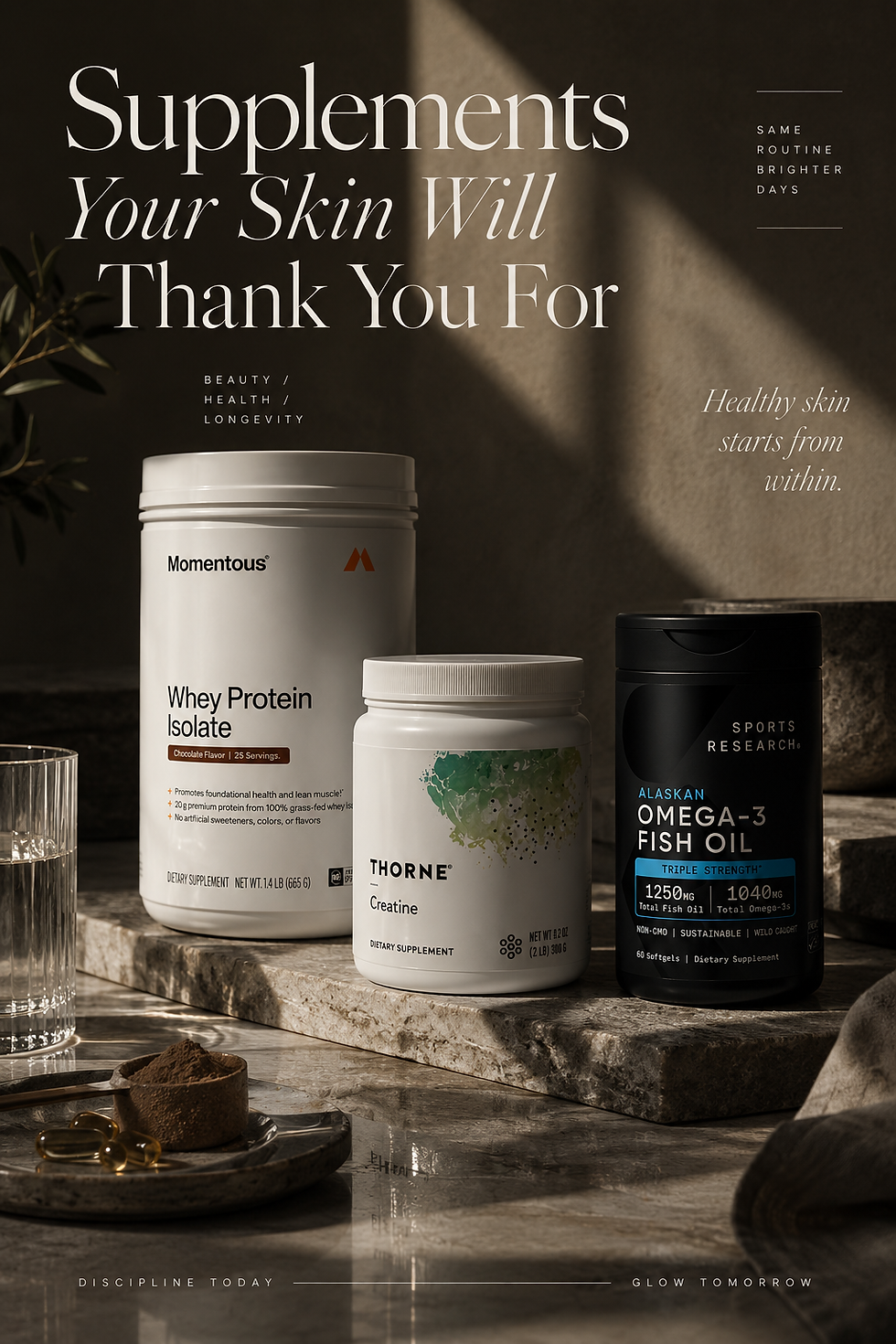
And no serum can completely outwork poor nutrition, low protein intake, dehydration, or a diet missing the things your body actually needs to build healthy tissue. So if we are talking about skin from the inside out, these are the supplements I think are most worth looking at. Not because they are trendy.
Because they actually support the things skin needs: protein, amino acids, healthy fats, antioxidant support, and muscle.
1. Protein
This is technically not a “supplement” in the traditional sense, but I am putting it first because it matters more than almost everything else on this list.
Your skin, hair, nails, muscles and connective tissue all depend on adequate protein.
If you are under-eating protein all day and then buying a $90 collagen powder, we may have the order of operations slightly backwards.
A protein shake is simply an easy way to help hit your daily protein target.
What I look for:
around 20–30 grams of protein per serving
minimal added sugar
a formula you actually enjoy enough to use consistently
Whey, plant-based, clear protein — I do not care.
The best protein is the one you will actually drink.
2. Collagen Peptides
Now we can talk collagen.
Collagen peptides provide amino acids that your body can use as building blocks for connective tissue.
They are not Botox in a scoop.
They are not going to erase your nasolabial folds by Thursday.
But consistent collagen peptide intake may support things like skin hydration, elasticity, and overall skin quality over time.
I think of collagen as an add-on to adequate protein, not a replacement for it.
3. Vitamin C
Vitamin C is one of those boring nutrients that quietly does a lot.
Your body needs vitamin C for normal collagen synthesis, which makes it especially relevant when we are talking about skin and connective tissue.
It also functions as an antioxidant.
And yes, I use vitamin C on my face and care about getting enough internally.
We are attacking this from multiple departments.
4. Omega-3 Fish Oil
Omega-3 fatty acids are one of my favorite “whole-body” supplements because they are not just about skin.
They support cardiovascular health, brain health, and normal inflammatory processes.
From a skin perspective, healthy fats also matter for maintaining normal barrier function and keeping skin from looking chronically dry and unhappy.
I specifically look for a fish oil that clearly lists EPA + DHA.
Because supplement labels enjoy making us do algebra.
5. Creatine
This is probably the one people do not expect to see in a skincare article.
Hear me out. I take creatine because I am interested in aging well, not just having nice skin. Creatine supports muscle performance and strength when paired with resistance training, and preserving muscle becomes increasingly important as we age.
And I think this is where the beauty conversation needs to mature a little.
Looking good at 40, 50 and 60 is not only about wrinkles. It is also about muscle, posture, strength, energy, and body composition.
Skin is part of the picture. It is not the entire picture.
Creatine monohydrate. Keep it simple.
6. Astaxanthin
Astaxanthin is one of my favorite antioxidant supplements.
It is a carotenoid antioxidant found naturally in certain algae and seafood, and it has been studied for its potential role in protecting cells from oxidative stress.
From a skin perspective, I like it because it fits into the bigger conversation around photoaging, oxidative stress, and skin resilience. I do not think of it as a miracle pill.
I think of it as another layer of antioxidant support — especially if your goal is long-term skin quality. Very much a “quietly doing its job in the background” supplement.
7. Liposomal Glutathione
Glutathione is one of the body’s major internal antioxidants.
It plays a role in helping cells manage oxidative stress, which is why it gets a lot of attention in the skin and wellness world.
I personally prefer liposomal glutathione because the delivery system is designed to improve absorption compared with standard oral forms.
People often talk about glutathione in relation to brightness and pigmentation, but I think it is better to frame it as general antioxidant support, not a whitening supplement.
Because we are aiming for healthy skin.
Not a completely different skin tone.
The Short Version
If I were building a skin-focused supplement routine, I would look at:
Protein — the raw materials
Collagen Peptides — connective tissue support
Vitamin C — collagen synthesis + antioxidant support
Omega-3 Fish Oil — healthy fats + barrier support
Creatine — muscle, strength, and healthy aging
Astaxanthin — antioxidant support
Liposomal Glutathione — internal oxidative-stress support
One Important Note
Supplements are exactly that: supplemental.
They do not replace eating enough protein, fruits and vegetables, sleeping, strength training, drinking water, wearing sunscreen, or correcting an actual deficiency with your medical provider.
And more supplements are not automatically better.
The goal is not to own a kitchen cabinet that looks like a vitamin store exploded inside it.
The goal is to identify the few things that actually make sense for you and take them consistently.
Boring things. Done repeatedly.
Comments